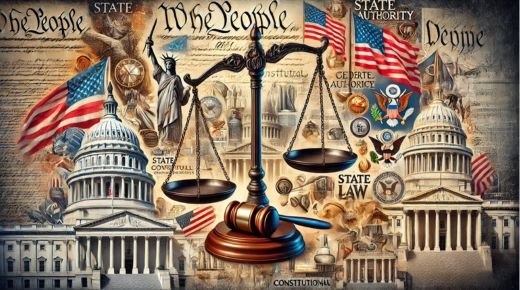
Category: Constitutional Law

  • Balancing Power – How Constitutional Law Defines the Relationship Between State and Federal Authorities

    Balancing Power – How Constitutional Law Defines the Relationship Between State and Federal Authorities

    In the United States, the relationship between state and federal authorities is a cornerstone of the nation’s governance. This dynamic interplay is crucial for maintaining the balance of power and ensuring that neither level of government oversteps its bounds. The U.S. Constitution, the supreme law of the land, is the primary framework that delineates this relationship. Understanding how constitutional law balances power between state and federal authorities is essential for grasping the complexities of American federalism.

    The Constitutional Foundation

    The U.S. Constitution, ratified in 1787, established a federal system of government, creating a dual sovereignty where both state and federal governments hold significant authority. This system was designed to address the limitations of the Articles of Confederation, which had created a weak central government and left states with most of the power. The Constitution’s Preamble sets the tone for this balance by emphasizing the need for a more effective union.

    The Constitution delineates the powers of the federal government in Articles I, II, and III, which respectively address legislative, executive, and judicial branches. The Tenth Amendment further clarifies the division of powers by stating that any power not expressly granted to the federal government is reserved for the states or the people. This amendment is a critical component in defining the limits of federal authority and ensuring that states retain their own powers.

    Federal Powers and Responsibilities

    The federal government is endowed with specific powers that are essential for the nation’s functioning. These include the power to regulate interstate commerce, conduct foreign affairs, provide for national defense, and enforce federal laws. For instance, the Commerce Clause (Article I, Section 8, Clause 3) gives Congress the authority to regulate trade between states and with foreign nations. This clause has been pivotal in several landmark Supreme Court cases that have expanded or limited federal regulatory powers.

    Moreover, the federal government has the power to levy taxes, borrow money, and establish a uniform system of currency. These functions are vital for maintaining economic stability and national cohesion. The Supremacy Clause (Article VI, Clause 2) ensures that federal laws take precedence over state laws in cases of conflict, reinforcing the authority of the federal government in areas where it has jurisdiction.

    State Powers and Responsibilities

    States retain significant powers and responsibilities under the Constitution. The Tenth Amendment underscores that any powers not granted to the federal government are reserved for the states or the people. This principle is the basis for the states’ authority to enact and enforce their own laws in areas not explicitly covered by federal law.

    State governments have authority over a wide range of matters, including education, transportation, and local law enforcement. For instance, states are responsible for setting educational standards and funding public schools. They also regulate transportation systems, including roads and public transit. Additionally, states have their own criminal justice systems, which handle most criminal cases unless federal jurisdiction is invoked.

    The Role of the Supreme Court

    The U.S. Supreme Court plays a crucial role in interpreting the Constitution and resolving disputes between state and federal authorities. Its decisions often shape the balance of power between the two levels of government. Landmark cases, such as McCulloch v. Maryland (1819) and Gibbons v. Ogden (1824), have significantly influenced the scope of federal authority.

    In McCulloch v. Maryland, the Supreme Court upheld the constitutionality of the federal bank and established the principle of implied powers, affirming that Congress has powers beyond those explicitly enumerated in the Constitution. This case reinforced the federal government’s ability to exercise powers necessary and proper for carrying out its functions.

    Gibbons v. Ogden addressed the Commerce Clause and affirmed federal authority over interstate commerce, ruling that the federal government had exclusive power to regulate navigation between states. This decision broadened the scope of federal regulatory power and limited states’ ability to impose restrictions on interstate trade.

    Balancing Power: Federalism in Practice

    The balance of power between state and federal authorities is not static; it evolves as the needs and priorities of the nation change. Federalism allows for flexibility and adaptability in governance, enabling states to experiment with policies and address local concerns while maintaining a unified national framework.

    One notable example of this dynamic balance is the Affordable Care Act (ACA). The ACA, enacted in 2010, sought to reform healthcare by expanding access to insurance coverage. While the federal government set national standards, states had the option to implement their own health insurance exchanges and expand Medicaid. This approach exemplifies how federal and state governments can collaborate and balance authority in policy implementation.

    Similarly, issues like marijuana legalization and sanctuary cities illustrate the ongoing negotiation between state and federal powers. Several states have legalized recreational or medicinal marijuana despite federal prohibition. Additionally, some local jurisdictions have declared themselves sanctuary cities, limiting cooperation with federal immigration enforcement. These cases highlight the tension and negotiation inherent in federalism.

    Challenges and Opportunities

    Balancing power between state and federal authorities presents both challenges and opportunities. Disputes often arise over jurisdictional boundaries and the extent of federal intervention. For example, debates over states’ rights versus federal authority have surfaced in areas such as environmental regulation, gun control, and healthcare.

    Opportunities for innovation and responsiveness also arise from this balance. States can act as laboratories of democracy, experimenting with policies and solutions that can later be adopted or adapted at the federal level. This flexibility allows for a diverse range of approaches to governance, reflecting the varied needs and preferences of different regions.

    Conclusion

    The relationship between state and federal authorities, as defined by constitutional law, is fundamental to the American system of governance. The U.S. Constitution provides a framework that balances power, ensuring that both levels of government have defined roles and responsibilities. Through the principles of federalism, the Constitution allows for flexibility and adaptability, enabling states to address local issues while maintaining national cohesion.

    The ongoing interpretation of constitutional provisions by the Supreme Court and the practical application of federalism in contemporary issues demonstrate the dynamic nature of this balance. As the nation continues to evolve, the balance of power between state and federal authorities will remain a critical aspect of American governance, shaping the nation’s legal and political landscape for years to come.

  • 10 Essential Questions About the Right to Privacy

    1. What is the right to privacy?

    Definition and scope: What exactly is privacy legally, socially, and ethically? Is it physical privacy, data privacy, or both?

    2. Why does the right to privacy matter?

    Implication for personal autonomy, dignity, and liberty. In what way does privacy safeguard individuals against undue interference and surveillance?

    3. How is the right to privacy protected under international law?

    Which international treaties and declarations (e.g. the Universal Declaration of Human Rights, Article 12) protect the right to privacy?

    4. What are the greatest privacy threats today?

    Think about surveillance by technology, hacking and other breaches of personal data, social networking, business exploitation of customer information, and governmental overreaching.

    5. How does law vary by country regarding a right to privacy?

    Compare frameworks like the General Data Protection Regulation (GDPR) in the EU with no federal-level privacy laws in other countries.

    6. How does technology shape privacy rights?

    Consider both challenges (mass surveillance, AI profiling) and opportunities (encryption, anonymization).

    7. Can privacy rights be in conflict with other rights or interests?

    Consider the tension between privacy and security, free expression, and public health measures.

    8. What obligations do corporations have to protect privacy?

    Talk about corporate accountability in data collection, storage, and sharing. What ethical standards should they meet?

    9. What role do individuals play in protecting their privacy?

    Personal responsibility, digital literacy, and the use of privacy-enhancing tools (e.g., VPNs, secure browsers).

    10. What’s the future of privacy rights in the digital age?

    How are emerging technologies such as quantum computing and blockchain going to redefine privacy? What trends and policies are shaping this future?

  • 8 Questions to Understand Constitutional Protections for Freedom of Religion

    1. What is the scope of “freedom of religion”?

    Does the constitution guarantee the right to practice any religion, or no religion at all?

    Does it protect both belief and conduct?

    2. What is the relationship between religion and the state?

    How does the constitution define the separation of church and state?

    Are government actions required to be neutral toward religion?

    3. Does the constitution protect religious expression?

    May the state and religious communities publicly declare religious beliefs?

    Must religious expression be restricted in particular places, like schools or work?

    4. To what extent may religious activity be limited?

    May the state prohibit practices harmful to public safety, health, or order?

    How are the state’s and religious communities’ laws reconciled when they clash?

    5. Does the constitution prohibit religious discrimination?

    Are persons and entities protected from discrimination both in public and private life because of their religions?

    How do religious minorities receive protection?

    6. What provisions exist for religious activity?

    Do the laws require reasonable accommodations for religious convictions and practice, such as exemptions or workplace modifications?

    How is such religion accommodation weighed against other social goals?

    7. How are religious instruction or education addressed in the constitution?

    To what extent are religious schools protected and can they be funded by the state?

    Can students and teachers freely practice religion in public schools?

    8. How does the constitution deal with new religious issues?

    Does it protect nontraditional or newly developed religions?

    How does it handle new challenges such as technology, bioethics?

  • 6 Commonly Asked Questions About Constitutional Interpretation

    1. What is constitutional interpretation?

    Constitutional interpretation is the process by which courts, scholars, and policymakers determine the meaning, scope, and application of constitutional provisions. It seeks to resolve ambiguities, conflicts, or gaps in the text of a constitution.


    2. What are the main approaches to constitutional interpretation?

    The main approaches include:

    • Textualism: Focuses on the plain meaning of the constitutional text as written.
    • Originalism: Seeks to understand the constitution as it was intended or understood by its framers or at the time of its adoption.
    • Living Constitution (or Pragmatism): Views the constitution as a dynamic document that evolves with society’s values and needs.
    • Structuralism: Interprets the constitution by examining its overall structure and the relationships it establishes between various branches of government.
    • Historical Analysis: Considers historical context and precedent.

    3. How do courts balance individual rights and governmental powers?

    Courts often use frameworks like strict scrutiny, intermediate scrutiny, or rational basis review to evaluate cases where individual rights conflict with governmental powers. The goal is to ensure that governmental actions are justified and proportional.


    4. What role do precedents play in constitutional interpretation?

    Precedents, or past judicial decisions, play a critical role through the principle of stare decisis. They provide consistency and predictability in the law, although courts may overturn precedents if they are deemed outdated or wrongly decided.


    5. How does constitutional interpretation vary across jurisdictions?

    Different countries adopt diverse methods based on their legal traditions. For example:

    • In the U.S., constitutional interpretation is heavily influenced by the judiciary, especially the Supreme Court.
    • In countries like the U.K., which has an uncodified constitution, interpretation relies more on parliamentary statutes and principles.
    • In civil law countries, constitutions are interpreted within codified frameworks, often by specialized constitutional courts.

    6. Can constitutional interpretation be influenced by politics?

    Yes, constitutional interpretation can be influenced by political ideologies, public opinion, or the composition of courts. Judges’ philosophical leanings and societal values can shape their decisions, raising debates about judicial impartiality.

  • 20 Questions and Answers About Voting Rights Laws

    1. What are voting rights laws?

    Voting rights laws are legal frameworks designed to protect the ability of citizens to participate in elections, ensuring fair and equal access to voting without discrimination.


    2. What is the Voting Rights Act of 1965?

    The Voting Rights Act of 1965 (VRA) is a landmark federal law in the United States that prohibits racial discrimination in voting.


    3. Who is eligible to vote under U.S. voting rights laws?

    Most U.S. citizens aged 18 and older, who meet residency and registration requirements, are eligible to vote.


    4. What is voter suppression?

    Voter suppression refers to actions that intentionally prevent or discourage certain groups of people from voting.


    5. How does the VRA address voter discrimination?

    The VRA bans literacy tests, provides federal oversight in certain jurisdictions, and ensures that voting practices do not disenfranchise minority groups.


    6. What is preclearance under the VRA?

    Preclearance required jurisdictions with a history of discrimination to get federal approval before changing voting laws. This provision was limited by the Supreme Court in 2013.


    7. What was the significance of Shelby County v. Holder (2013)?

    This Supreme Court decision invalidated the formula used to determine which jurisdictions needed preclearance, effectively weakening the VRA.


    8. What are common forms of voter suppression?

    Examples include strict voter ID laws, voter roll purges, limited polling places, and reduced early voting opportunities.


    9. Are voter ID laws discriminatory?

    Supporters argue they prevent fraud, but critics say they disproportionately affect minorities, the elderly, and low-income individuals.


    10. What is the role of the Department of Justice (DOJ) in voting rights?

    The DOJ enforces voting rights laws, investigates violations, and litigates to protect voter access.


    11. How do states regulate voting?

    States determine voter registration requirements, polling locations, and early/absentee voting processes, within federal guidelines.


    12. What are gerrymandering and its impact on voting rights?

    Gerrymandering is manipulating electoral district boundaries to favor a party or group, potentially diluting voters’ influence.


    13. How do voting rights laws protect disabled voters?

    The Americans with Disabilities Act (ADA) and related laws ensure accessibility in voting, including assistance and accessible polling places.


    14. What protections exist for non-English-speaking voters?

    The VRA requires jurisdictions with significant language minority populations to provide bilingual ballots and assistance.


    15. Can ex-felons vote?

    Laws vary by state; some restore voting rights upon release, others after parole/probation, and some permanently disenfranchise certain felons.


    16. What is mail-in voting, and is it secure?

    Mail-in voting allows voters to submit ballots by post. Studies show it is generally secure, with fraud being extremely rare.


    17. What is the National Voter Registration Act (NVRA)?

    The NVRA, or “Motor Voter Act,” makes it easier to register to vote by allowing registration at DMV offices and public agencies.


    18. What role do courts play in voting rights disputes?

    Courts adjudicate cases involving voting laws, such as challenges to voter ID laws, redistricting plans, and other potential barriers.


    19. What are “voter roll purges”?

    This is the practice of removing inactive or ineligible voters from registration lists, which can sometimes lead to eligible voters being wrongly removed.


    20. How can citizens protect their voting rights?

    Citizens can stay informed, check registration status, report suppression, and support policies or organizations advocating for fair voting access.